
What Is Tennessee Whiskey?
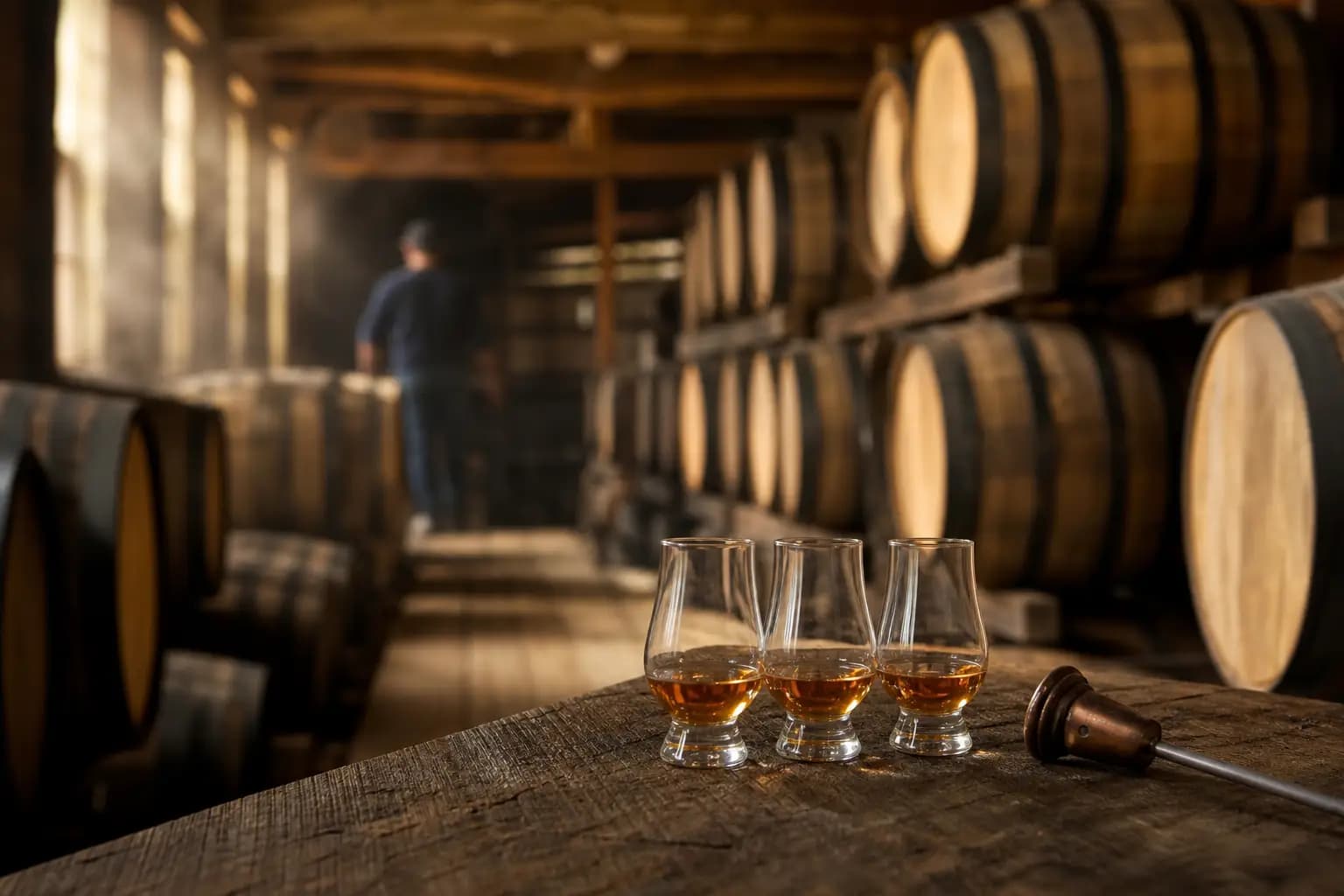
Tennessee whiskey is a legal style of whiskey as much as a state tradition. To use the name, a spirit has to be made in Tennessee, use a grain recipe of at least 51 percent corn, meet proof limits, age in new charred oak barrels in Tennessee, pass through maple charcoal before aging, and be bottled at at least 80 proof. That maple charcoal step, called the Lincoln County Process, is a defining part of the Tennessee whiskey label, with a narrow state law exception.
Key facts
- Tennessee law has controlled use of the terms "Tennessee Whiskey," "Tennessee Whisky," "Tennessee Sour Mash Whiskey" and "Tennessee Sour Mash Whisky" since 2013.
- The legal grain recipe has to be at least 51 percent corn.
- The Lincoln County Process filters new whiskey through maple charcoal before barrel aging.
- Tennessee banned whiskey production in 1910.
Own a house in Tennessee you are thinking of selling? See how our cash offer works.
The Legal Definition
Tennessee law treats the name as more than a casual regional label. Since 2013, an intoxicating liquor may not be advertised, described, labeled, named, sold or referred to as "Tennessee Whiskey," "Tennessee Whisky," "Tennessee Sour Mash Whiskey" or "Tennessee Sour Mash Whisky" unless it meets the state requirements. The law ties the label to where the whiskey is made, what grain goes into it, how strong it can be during distillation and barrel entry, how it is filtered, where it ages, and its final bottling strength.
The core recipe rule is corn. Tennessee whiskey must be made from a grain mixture that is at least 51 percent corn, distilled to no more than 160 proof, placed into the barrel at no more than 125 proof, aged in new charred oak barrels in Tennessee, filtered through maple charcoal before aging, and bottled at not less than 80 proof. In plain terms, the label is controlled by both place and process.
There is one narrow exception to the maple charcoal requirement. Tennessee law says that requirement does not apply to a qualifying distillery in a county that authorized manufacturing by referendum after January 1, 1979 and before January 1, 1980, with state licensing after January 1, 2000 and before January 1, 2001.
Charcoal Mellowing and the Lincoln County Process
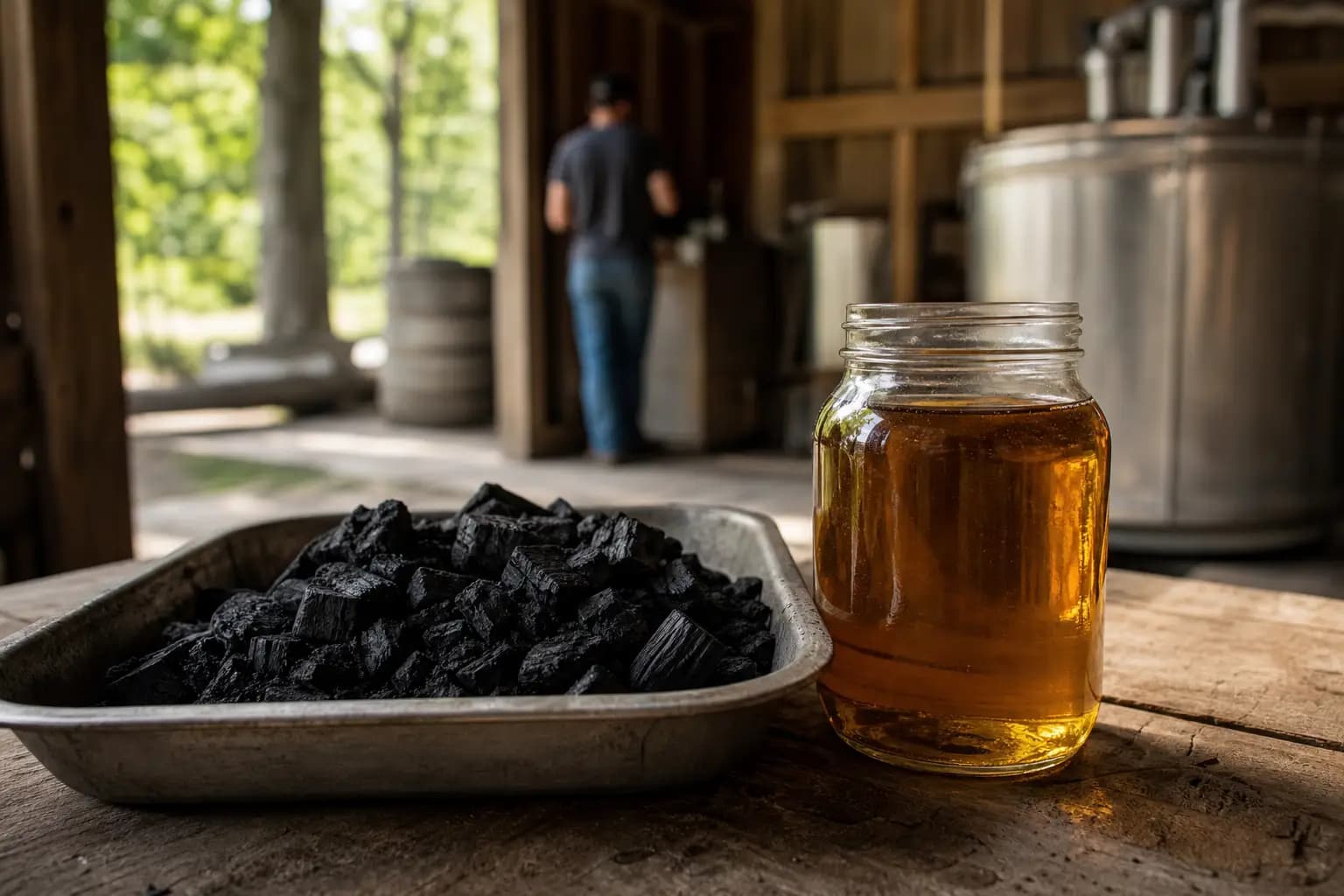
The most famous step in Tennessee whiskey is charcoal mellowing, also called the Lincoln County Process. It happens before the whiskey goes into barrels: the fresh distillate passes through maple charcoal, usually sugar maple charcoal, before aging. The Tennessee Whiskey Trail describes this step as part of the normal order of production, with the spirit filtered through sugar maple charcoal and then aged in new charred oak barrels.
The process is required for a product to be labeled Tennessee whiskey, except for the narrow state law exception. University of Tennessee Institute of Agriculture researchers describe the Lincoln County Process as passing the fresh whiskey distillate through a bed of charcoal, usually made from burnt sugar maple, before barrel aging. Their work also notes that the exact process differs from distiller to distiller, and Tennessee law requires the step but does not regulate exactly how it must be performed.
The same research found that charcoal treatment generally decreased malty, rancid, fatty and roasty aromas in whiskey distillates. It did not add new odorants to the distillate in that study, but appeared to remove selected ones. That detail helps explain why the step is often discussed as mellowing rather than flavoring.
How Tennessee Whiskey Differs From Bourbon
Tennessee whiskey and bourbon are close relatives under American whiskey rules. Federal regulations define whiskey as a fermented grain distillate, distilled at less than 190 proof, stored in oak barrels, and bottled at not less than 80 proof. Tennessee whiskey adds a state law definition for spirits using the Tennessee whiskey name.
Tennessee law adds Tennessee identity and charcoal mellowing. The spirit has to be manufactured in Tennessee and aged in new charred oak barrels in Tennessee. It also has to be filtered through maple charcoal before aging, unless the narrow exception applies.
That means the simplest difference is not just the mash bill. Bourbon is a federal whiskey category, while Tennessee whiskey is a Tennessee label controlled by state law. A bottle using the Tennessee whiskey name carries Tennessee manufacture, Tennessee aging and the Lincoln County Process unless the narrow exception applies.
| Rule point | Bourbon under federal rules | Tennessee whiskey under Tennessee law |
|---|---|---|
| Where made | Manufactured in Tennessee and aged in Tennessee | |
| Mash | At least 51 percent corn | |
| Distillation and barrel entry | Distilled to 160 proof or less and placed in the barrel at 125 proof or less | |
| Barrels | New charred oak barrels in Tennessee | |
| Charcoal step | Filtered through maple charcoal before aging, with a narrow exception |
Prohibition and Later Reform
Tennessee moved against whiskey before national Prohibition. In 1910, the state banned whiskey production a full decade before the federal ban of 1920. That earlier state action is part of the long legal history behind the modern Tennessee whiskey label.
Modern Tennessee whiskey tourism grew after legal barriers eased. The Tennessee Whiskey Trail says reform came in 2009, when the state removed many Prohibition era barriers to entry. That later reform helped set the stage for a broader public focus on Tennessee distilling and whiskey heritage.
Nearest Green and African American Distilling History
Nathan "Nearest" Green is central to the fuller history of Tennessee whiskey. A Tennessee General Assembly resolution describes Green as the first recorded African American master distiller of whiskey, the first master distiller for Jack Daniel Distillery, and the man who taught Jack Daniel how to make whiskey. The same resolution memorialized his life and his contributions to Tennessee whiskey.
Green's story also points to a broader labor history. The resolution states that male African American slaves made up most of the distilling workforce in Southern history and often played skilled roles in making whiskey. It also says those contributions have only lately been recognized.
The resolution connects Green directly to charcoal mellowing. It says he was especially skilled in charcoal leaching or charcoal mellowing, in which unaged whiskey passes through several feet of maple charcoal, removing impurities and imparting a slight sweetness. It also says Green was instrumental in the development of the Lincoln County Process, which remains one of the defining marks of Tennessee whiskey.
Frequently asked questions
Is Tennessee whiskey the same as bourbon?
No. Tennessee whiskey is a Tennessee label controlled by state law. It requires manufacture in Tennessee, aging in Tennessee and maple charcoal filtering before aging, with a narrow exception.
What is the Lincoln County Process?
The Lincoln County Process is the charcoal mellowing step associated with Tennessee whiskey. Fresh whiskey distillate is filtered through maple charcoal, usually sugar maple charcoal, before it goes into barrels for aging.
Does all Tennessee whiskey have to be charcoal mellowed?
Tennessee law requires maple charcoal filtering before aging for the Tennessee whiskey label. The law includes a narrow exception for a qualifying distillery that meets specific county referendum and licensing conditions.
Why does Tennessee whiskey have to be at least 51 percent corn?
The 51 percent corn rule is part of Tennessee's state definition for spirits using the Tennessee whiskey label.
What is the Tennessee Whiskey Trail?
The Tennessee Whiskey Trail is a heritage route created to connect and promote the state's distilling tradition.
Can the label use "whisky" instead of "whiskey"?
Yes. Federal regulations say the word may be spelled either "whisky" or "whiskey." Tennessee law also covers both "Tennessee Whiskey" and "Tennessee Whisky," along with sour mash versions of those terms.
Sources
Checked against each source on November 28, 2026. Opening hours, prices and event dates change, so check with the venue before you go. The illustrations are AI generated and do not show real places.
- Bill Information, HB 1084 (Tennessee General Assembly)
- 27 CFR § 5.143, Whisky (Legal Information Institute, Cornell Law School)
- Whiskey 101 (Tennessee Whiskey Trail / Tennessee Distillers' Guild)
- Unravelling the Secrets of Tennessee Whiskey (University of Tennessee Institute of Agriculture)
- House Joint Resolution 782 (Tennessee General Assembly)
More guides in Tennessee
Sightseeing Memphis
What To See At Graceland In MemphisTour the mansion, Elvis Presley's Memphis exhibits, custom jets, car museum and planning basics for a Graceland Memphis visit.
Events Tennessee
What Is Bonnaroo In Tennessee?Learn what Bonnaroo in Tennessee is, where it happens in Manchester, how camping works and which traditions shape the festival.
Sightseeing Chattanooga
What To See At The Tennessee Aquarium In ChattanoogaPlan the Tennessee Aquarium in Chattanooga: River Journey, Ocean Journey, freshwater animals, conservation and the riverfront setting.
Events Nashville
What Is CMA Fest in Nashville?Learn what CMA Fest in Nashville is, how downtown stages and Fan Fair X work, and how the event supports music education.
Sightseeing Nashville
What To Know About The Grand Ole Opry In NashvilleSee how the Grand Ole Opry blends a live country concert, a WSM Radio broadcast, and backstage tours at its Nashville home since 1974.
Outdoors Chattanooga
Lookout Mountain In Chattanooga: Trails And ViewsPlan Lookout Mountain in Chattanooga with viewpoints, NPS trails, battlefield stops, paid overlooks, parking basics and outdoor rules.