
What Is The Indianapolis Motor Speedway Museum?
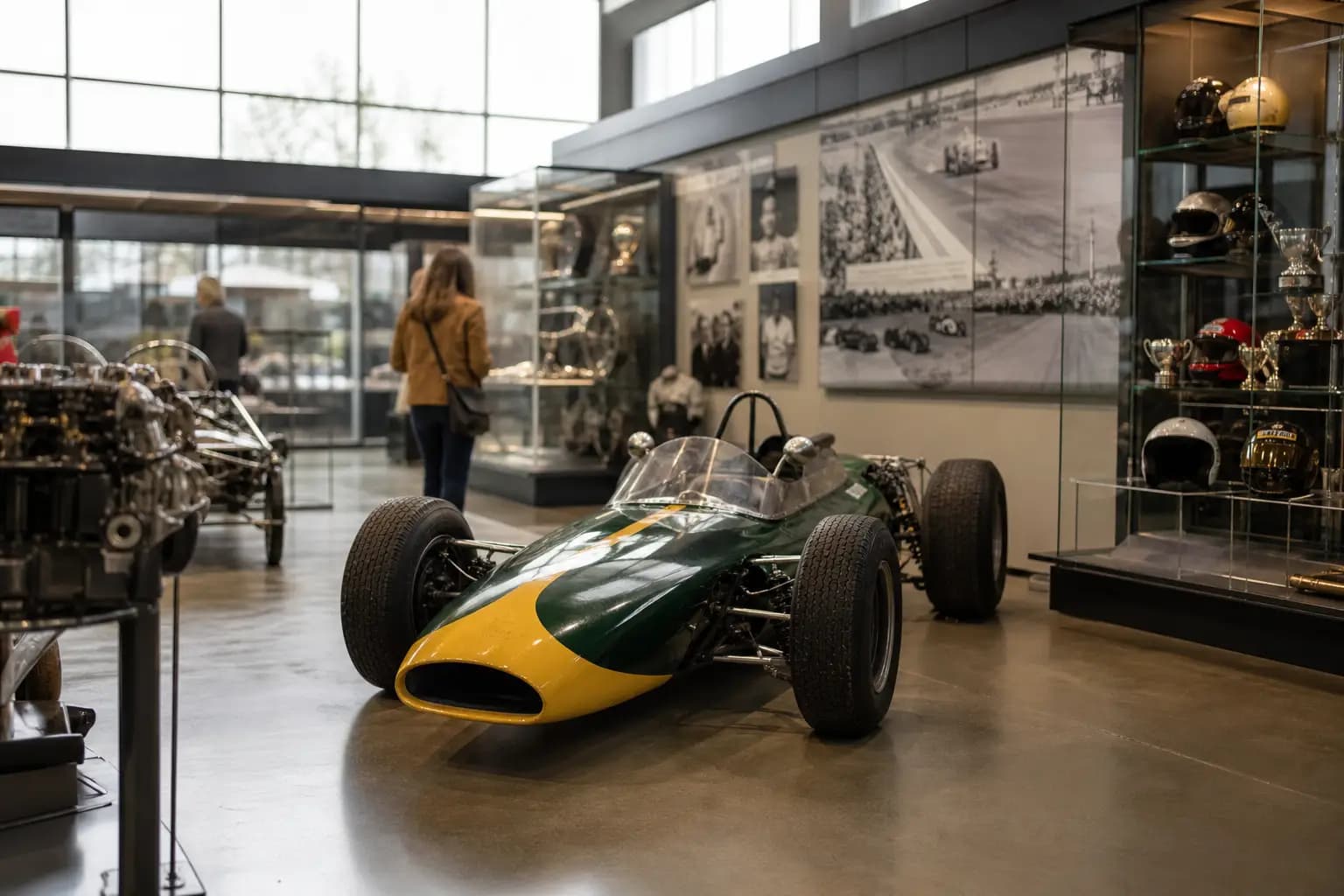
The Indianapolis Motor Speedway Museum is the history keeper for the track and the Indianapolis 500, with cars, trophies, photographs, fine art and racing artifacts inside the Speedway between Turns 1 and 2. Its story begins with the Speedway's 1909 creation, the first Indianapolis 500 in 1911 and Tony Hulman's postwar rescue of the track. A visit connects race cars to Indianapolis industry, aviation experiments, wartime engineering and the people who shaped motorsports.
Key facts
- The Indianapolis Motor Speedway Company was officially formed on March 20, 1909 by Carl G. Fisher, James A. Allison, Arthur C. Newby and Frank H. Wheeler.
- The first Indianapolis 500 ran on May 30, 1911, and Ray Harroun won in a locally built Marmon race car.
- The Indianapolis Motor Speedway Museum opened in 1956 and moved to its current location inside the Speedway between Turns 1 and 2 in 1976.
- The museum's collection includes more than 55,000 artifacts and over 200 vehicles.
- The Hall of Fame began in 1952 as the Auto Racing Hall of Fame and moved from Detroit to Indianapolis in 1962.
Own a house in Indianapolis you are thinking of selling? See how our cash offer works.
Why The Museum Matters
The museum's own mission is to celebrate and preserve the history behind the Indianapolis Motor Speedway and the Indianapolis 500. It sits inside the Speedway between Turns 1 and 2, so the setting is part of the story rather than a backdrop. The Speedway was constructed in 1909, built as a 2.5 mile racetrack, and later became a National Historic Landmark.
Its collection includes more than 55,000 artifacts and over 200 vehicles. That scale lets the museum tell a bigger story than race results alone: design, mechanical work, trophies, photographs, art and the public memory of a place that shaped Indianapolis. For a wider city view, pair the museum with what Indianapolis is known for.
The Speedway Before The Museum
Long before there was a museum, the site was imagined as a proving ground. Carl G. Fisher, James A. Allison, Arthur C. Newby and Frank H. Wheeler officially formed the Indianapolis Motor Speedway Company on March 20, 1909, after pooling resources and purchasing land in December 1908. Fisher's vision was to build an automobile testing ground to support Indiana's growing automotive industry.
The early track was practical before it was romantic. The first course was a four sided 2.5 mile circuit of crushed stone and tar, and the first race took place on August 19, 1909. The macadam surface was replaced that fall with more than 3 million brick paving blocks.
One yard of brick was left exposed at the start finish line. That small strip gives today's Speedway a physical link to the first decades of racing on the grounds. It also helps explain why the museum's cars matter most when they are understood in relation to the track beneath them.
The First 500 And The Marmon Wasp
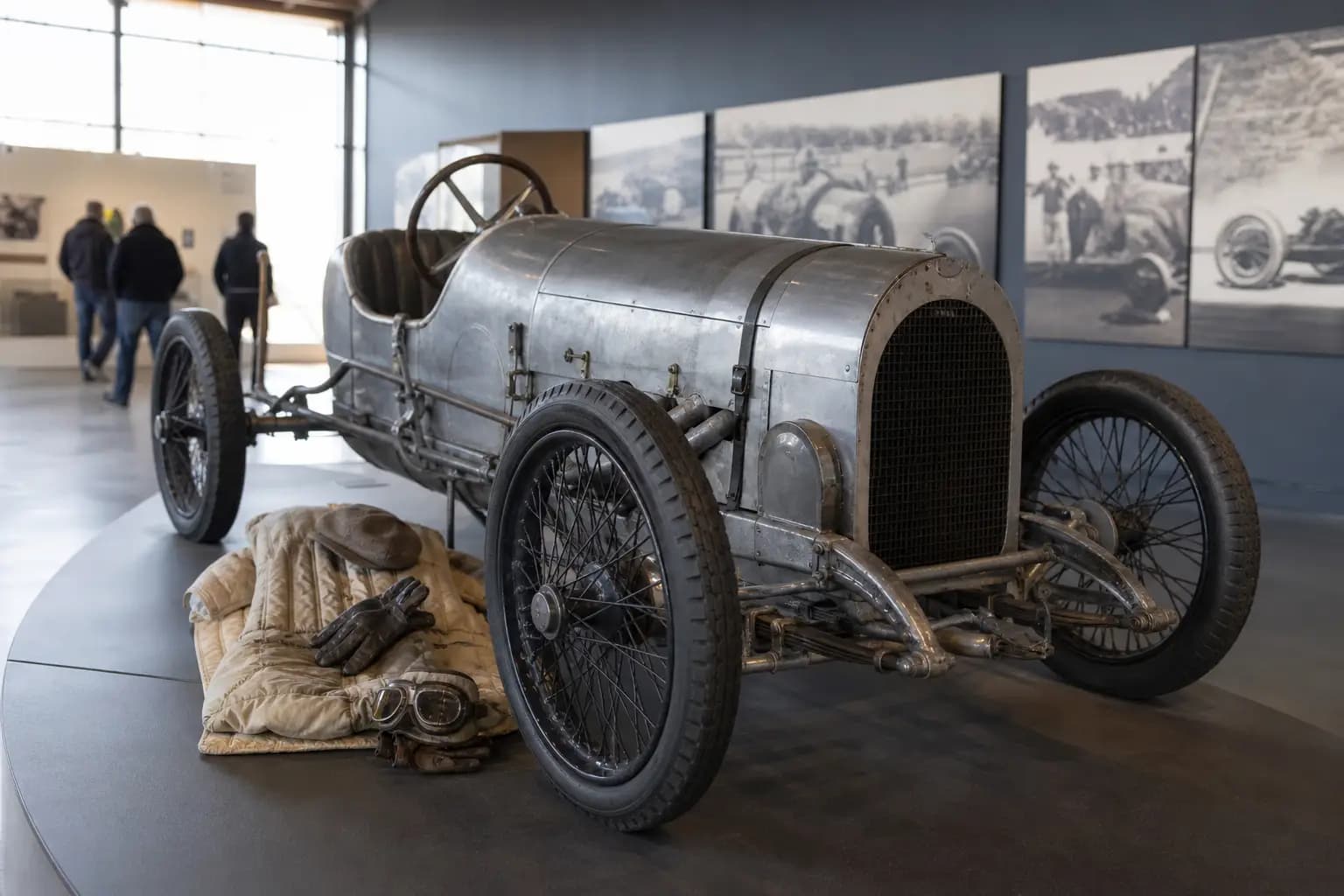
The first Indianapolis 500 gave the Speedway its defining race story. A crowd estimated as high as 85,000 watched the inaugural Indianapolis 500 on May 30, 1911, and the race was won in six hours and 42 minutes by a racing version of the locally built Marmon passenger car. That win tied the race to Indianapolis manufacturing from the beginning.
Ray Harroun came from the Marmon engineering department, helped design the winning car and installed what is believed to have been the first rearview mirror used on an automobile. Other teams had objected during practice because his single seat car had no riding mechanic. The solution became one of the race's most remembered pieces of early engineering.
The start was also new. Track founder Carl Fisher led the 40 car field in a Stoddard-Dayton passenger car for one unscored lap, and Indianapolis Motor Speedway history describes the start as believed to be the first mass rolling start for an automobile race and possibly the first use of a pace car at a major event. Inside the museum, early race history works best when read as experiment, spectacle and local industry all at once.
Aviation, Allison And Wartime Industry
Racing was only part of the Speedway's early public life. In June 1909, nine balloons from around the United States gathered at the Speedway for the first national balloon race. Carl Fisher, who built the Speedway, was a balloon enthusiast, and the event put the new grounds into the age of air sport almost at once.
A year later, the Speedway hosted the first licensed aviation meet in the United States from June 13 to 18, 1910, with Orville and Wilbur Wright and their team of six planes and pilots. The same grounds that tested cars also staged the drama of early flight. That history makes the Speedway more than a racing oval in the story of transportation.
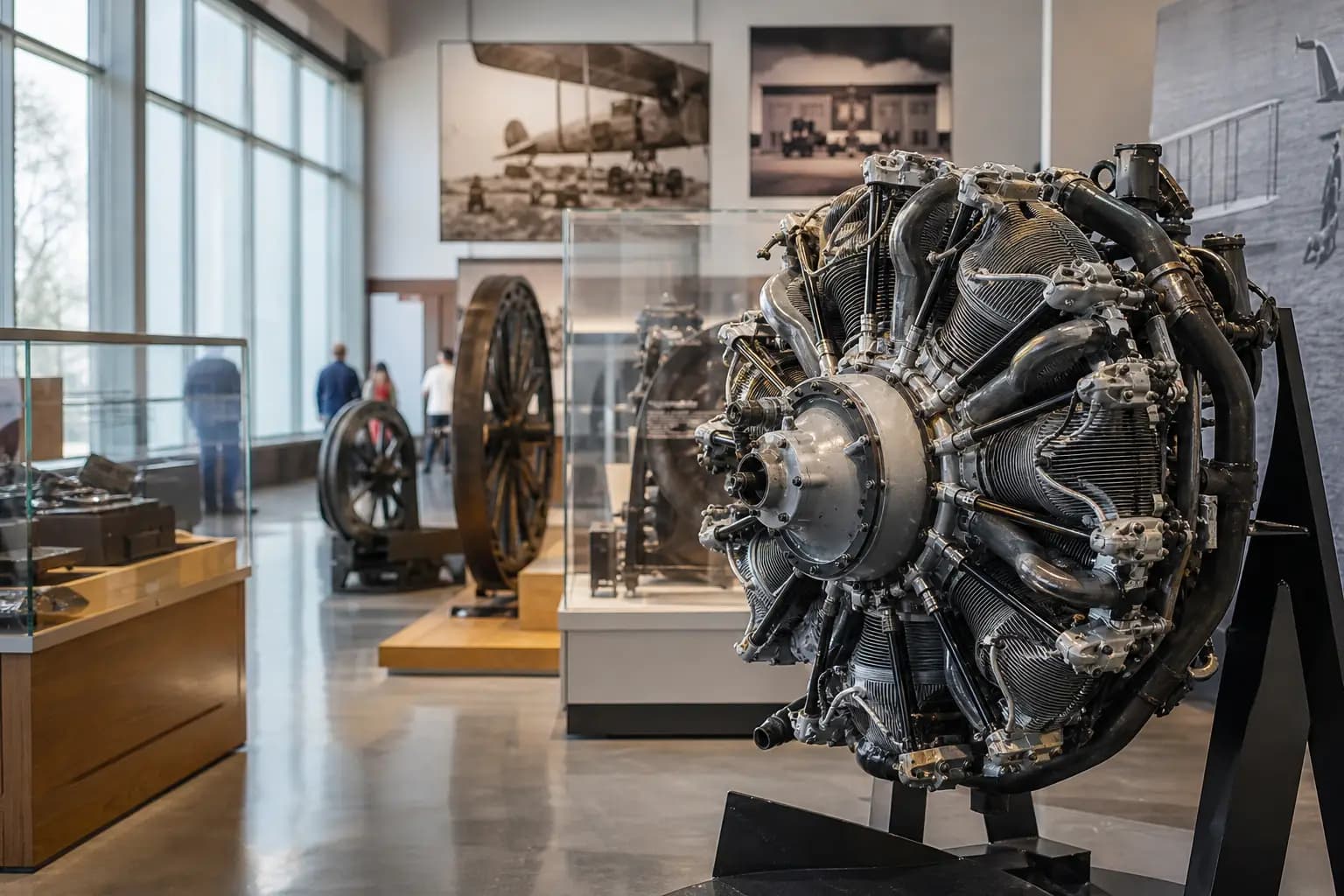
James Allison's industrial story also runs through the museum's subject. James Allison helped establish Indianapolis Speedway Team Co. in 1915 and later built a precision machine shop near the Speedway to improve race cars. When the United States entered World War I in 1917, the 500 mile race was suspended and Allison devoted shop resources to the war effort, including parts for Liberty aircraft engines.
During World War II, Allison Division built 70,000 liquid cooled V-1710 engines for fighter aircraft and grew to more than 23,000 employees. Those facts widen the museum's frame from drivers and trophies to machine shops, aviation, military production and skilled labor. The Speedway story belongs to the history of Indianapolis industry as much as to the history of sport.
From Hulman To The Hall Of Fame
The museum's institutional story begins after another crisis. Anton Hulman Jr. bought the Indianapolis Motor Speedway in 1945 after World War II. Hulman worked with the first curator, Karl Kizer, and three time Indianapolis 500 winner Wilbur Shaw to save the Speedway and revive the Indianapolis 500, and the early museum displayed about a dozen cars, including Shaw's race winning Maserati.
The Indianapolis Motor Speedway Museum officially opened in 1956 on a nonprofit basis. In 1976, the museum opened in its current location inside the Speedway between Turns 1 and 2. That move placed the collection within the oval, close to the physical place its objects explain.
The Hall of Fame adds a second timeline inside the museum. The Hall of Fame began in 1952 as the Auto Racing Hall of Fame under the Contest Board of the American Automobile Association, and Anton Hulman Jr. moved it from Detroit to Indianapolis in 1962. It took the Indianapolis Motor Speedway Hall of Fame name in 2018, and more than 150 people have been inducted for contributions to motorsports.
What To Look For In The Museum
The museum is strongest when you look for layers rather than a simple line of trophies. Its larger collection includes more than 55,000 artifacts and over 200 vehicles, so any display is a selection from a much deeper archive. Cars are the obvious draw, but the surrounding photographs, trophies, art and artifacts help explain why the Speedway became a cultural place as well as a racing venue.
Named spaces help visitors connect objects to eras. The Heritage Group Gasoline Alley Gallery uses seven garages to represent different periods of the Indianapolis Motor Speedway through cars, decor and audio and visual elements. The garage idea fits the subject well because Speedway history has always depended on people working around machines before the green flag.
The Borg-Warner Trophy is presented as a focal point, and winning Indianapolis 500 cars are displayed on two levels, 17 on the main level and 12 on the lower level. The tour lounge includes an interactive 3D track map showing the evolution of the Speedway from 1909 to the present. Read together, the exhibits make the museum a place to understand engineering, celebrity, labor and memory at the same time.
Frequently asked questions
Where is the Indianapolis Motor Speedway Museum?
The museum is inside the Indianapolis Motor Speedway between Turns 1 and 2. That location matters because the collection sits within the racing setting whose history it preserves.
Why was the Indianapolis Motor Speedway Museum created?
The museum's mission is to celebrate and preserve the history behind the Indianapolis Motor Speedway and the Indianapolis 500. Its roots connect to Anton Hulman's 1945 purchase of the Speedway and the effort by Hulman, Karl Kizer and Wilbur Shaw to save the track and revive the race.
What happened at the first Indianapolis 500?
The first Indianapolis 500 took place on May 30, 1911, before a crowd estimated as high as 85,000. Ray Harroun won in a racing version of the locally built Marmon passenger car after a race time of six hours and 42 minutes.
What are the bricks at the start finish line?
The track was resurfaced in 1909 with more than 3 million brick paving blocks after its first macadam surface. One yard of brick was left exposed at the start finish line after asphalt later covered the racing surface.
Does the museum include the Hall of Fame?
Yes. The museum is home to the Indianapolis Motor Speedway Hall of Fame, which began in 1952 as the Auto Racing Hall of Fame and moved from Detroit to Indianapolis in 1962.
What should visitors look for besides race cars?
Look for the museum's broader objects and spaces, including trophies, photographs, fine art, artifacts, the Heritage Group Gasoline Alley Gallery, the Borg-Warner Trophy display and the interactive 3D track map. Those pieces connect the cars to engineering, people, events and the changing Speedway itself.
Sources
Checked against each source on November 20, 2026. Opening hours, prices and event dates change, so check with the venue before you go. The illustrations are AI generated and do not show real places.
- About Us (Indianapolis Motor Speedway Museum)
- Indianapolis Motor Speedway Museum Announces Completion of $60.5 Million, 17 Month Renovation (Indianapolis Motor Speedway Museum)
- Hall of Fame (Indianapolis Motor Speedway Museum)
- Digital Archive (Indianapolis Motor Speedway)
- The First 500 (Indianapolis Motor Speedway)
- National Register of Historic Places Inventory Nomination Form (National Park Service, U.S. Department of the Interior)
- Aviation at Indianapolis Motor Speedway (Indiana Historical Bureau, State of Indiana)
- Allison Machine Shop (Indiana Historical Bureau, State of Indiana)
More guides in Indiana
Events Indianapolis
What to Expect at the Indiana State FairLearn the Indiana State Fair's history, fairgrounds background, agriculture, Indiana Grown products, rides and practical visitor tips.
Sightseeing Indianapolis
What Is Indianapolis Known For?Learn what Indianapolis is known for: Monument Circle, racing heritage, canals, cultural trails, museums, gardens and historic districts.
Food Indiana
What Is Sugar Cream Pie In Indiana?Learn what sugar cream pie is, why Indiana calls it Hoosier Pie, how its pantry recipe developed, and where visitors can try it.
Sightseeing Bloomington
Things to Do in Bloomington, IndianaSee Bloomington's 1908 Monroe County Courthouse, Indiana University, Griffy Lake Nature Preserve, and a Buddhist center on 108 acres.
Food Indiana
What food is Indiana known for?Learn the Indiana food traditions visitors ask about, from breaded pork tenderloin and sugar cream pie to popcorn and persimmons.
Food Indiana
What Is the Indiana Pork Tenderloin Sandwich?Learn what makes Indiana's pork tenderloin sandwich famous, from Nick's Kitchen origins to toppings, food trails and tenderloin festivals.